
Stage fear guide
How to Remove Stage Fear
Quick answer: To remove stage fear, do not wait to feel confident first. Use these 8 practical ways:
- Prepare a speech you cannot lose: one opening line, three points, one closing line.
- Speak from 5–7 keywords, not a full script.
- Practise it out loud and record one attempt.
- Speak to bigger audiences step by step.
- On the day, slow your breathing with a long breath out.
- Call the feeling excitement: say "I am excited".
- Pause after your first line.
- Talk to three zones of the room, not one face.
Prefer to talk? Call +91 95423 44555, 9 am to 7 pm.
Table of contents
Key takeaways
- Stage fear is a normal stress response. It shrinks with repetition, not by waiting for it to go away.
- The fear is strongest in the first minute, so plan and practise your opening line the most.
- A long, slow breath out and saying "I am excited" are two quick resets backed by research.
- Build up your audience step by step: phone camera, one person, a small group, the full room.
- If fear stops you from everyday life, speak to a doctor or counsellor as well.
What is stage fear?
Stage fear is the nervousness you feel before or while speaking in front of an audience. It is a normal stress response, and it gets smaller with safe practice.
Stage fear, also called stage fright or performance anxiety, is the nervousness you feel before or while speaking in front of people.
Your body treats the audience as a threat, so:
- Your heart beats faster.
- Your hands shake.
- Your mouth goes dry.
- Your mind can go blank for a moment.
You are far from alone:
- In the 2026 Chapman University Survey of American Fears, 28.9% of adults said they were afraid or very afraid of public speaking.1
- You may have read that 75% of people fear public speaking more than death.
- That figure is repeated often, but it is not what careful surveys find.
- The real number is lower, and it is still large.
The useful part:
- Stage fear is not a personality type.
- It is a reaction your body learns.
- It gets smaller every time you speak and nothing bad happens.
- The 12 steps below are designed to give you those safe repetitions.
Stage fear, stage fright and glossophobia: what is the difference?
Stage fear, stage fright and glossophobia describe the same core experience with different degrees and contexts:
- Stage fear
- Nervousness before or while speaking or performing in front of people. This is the term most people use in India.
- Stage fright
- The same feeling. The term is more common in the US and UK, and for actors and musicians.
- Performance anxiety
- The wider group of fears about being watched while you perform.
- Mayo Clinic counts fear of public speaking as one form of it, along with stage fright and test anxiety.7
- Public speaking anxiety
- Nervousness about speaking to an audience in particular, from a class presentation to a wedding speech.
- Glossophobia
- The formal name for the fear of public speaking. It comes from the Greek words for tongue (glōssa) and fear (phobos).
- Social anxiety disorder
- A mental health condition with intense fear of social situations. It needs professional help, not only practice.6
What causes stage fear?
Stage fear is caused by the fight-or-flight response.
- When you feel watched and judged, your body releases adrenaline.
- Adrenaline raises your heart rate, speeds up your breathing and dries your mouth.8
The most common triggers are:
- Fear of judgement: worrying about what the audience will think of you.
- Little speaking practice: an unfamiliar situation feels unsafe to your body.
- A past bad experience: going blank or being laughed at once.
- Perfectionism: believing one mistake will ruin the whole speech.
- The illusion of transparency: believing your nervousness is far more visible to the audience than it is.9
- Speaking in a second language: handling the words and the fear at the same time.
What are the signs of stage fear?
The signs of stage fear show up in three places: your body, your thoughts and your behaviour.
- Body: fast heartbeat, shaking hands or legs, dry mouth, sweating and a shaky voice.
- Thoughts: going blank, racing negative thoughts and expecting the worst.
- Behaviour: avoiding chances to speak, rushing, reading from slides and avoiding eye contact.
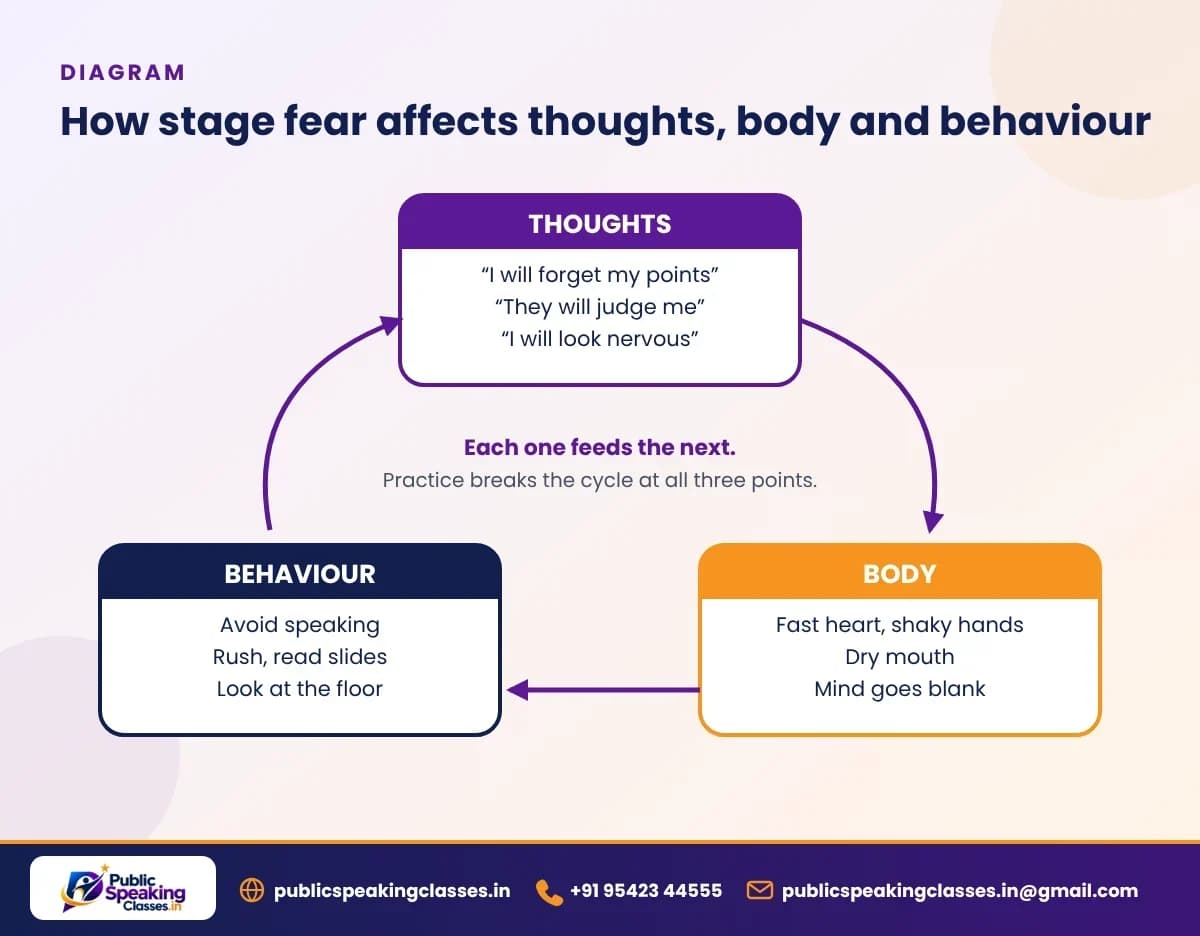
The steps in this guide work on all three parts:
- Thoughts: steps 1 and 7 (write down the fear, say "I am excited").
- Body: steps 6 and 8 (the 60-second reset and the voice warm-up).
- Behaviour: steps 9 to 12 (feet, pause, three zones, the 3-second rescue).
How common is stage fear?
Stage fear affects people at every stage of life:
- Students: class presentations, seminars, viva exams and campus placements.
- Working professionals: meetings, client calls, demos and appraisals.
- Children and teens: school assemblies, elocution and debates.
- Anyone at an event: wedding speeches, anchoring and toasts.
28.9%
of US adults were afraid or very afraid of public speaking in 2026.1
12 studies
in one meta-analysis found video feedback improves speaking skills without raising anxiety.2
5 minutes
of daily breathwork improved mood and reduced anxiety in a randomised study.3
140 people
took part in the speech experiment that tested saying "I am excited".5
Trainer's note
- In class, the hardest moment is rarely the middle of a speech.
- It is the few seconds after the first line, when every face is looking at you.
- That is why several steps below focus on your opening.
- If the first 30 seconds go well, the rest usually follows.
How strong is your stage fear? Take the self-assessment
Your stage fear level depends on how often fear changes what you do. These 10 questions give you a score from 0 to 20.
Answer 10 quick questions. It takes about one minute.
- Choose how often each statement is true for you.
- Your answers stay in your browser. Nothing is sent to us.
This self-assessment is for practice planning only. It is not a medical or psychological test.
How to remove stage fear: 12 steps
You remove stage fear by preparing a simple speech, practising it out loud and speaking to bigger audiences step by step.
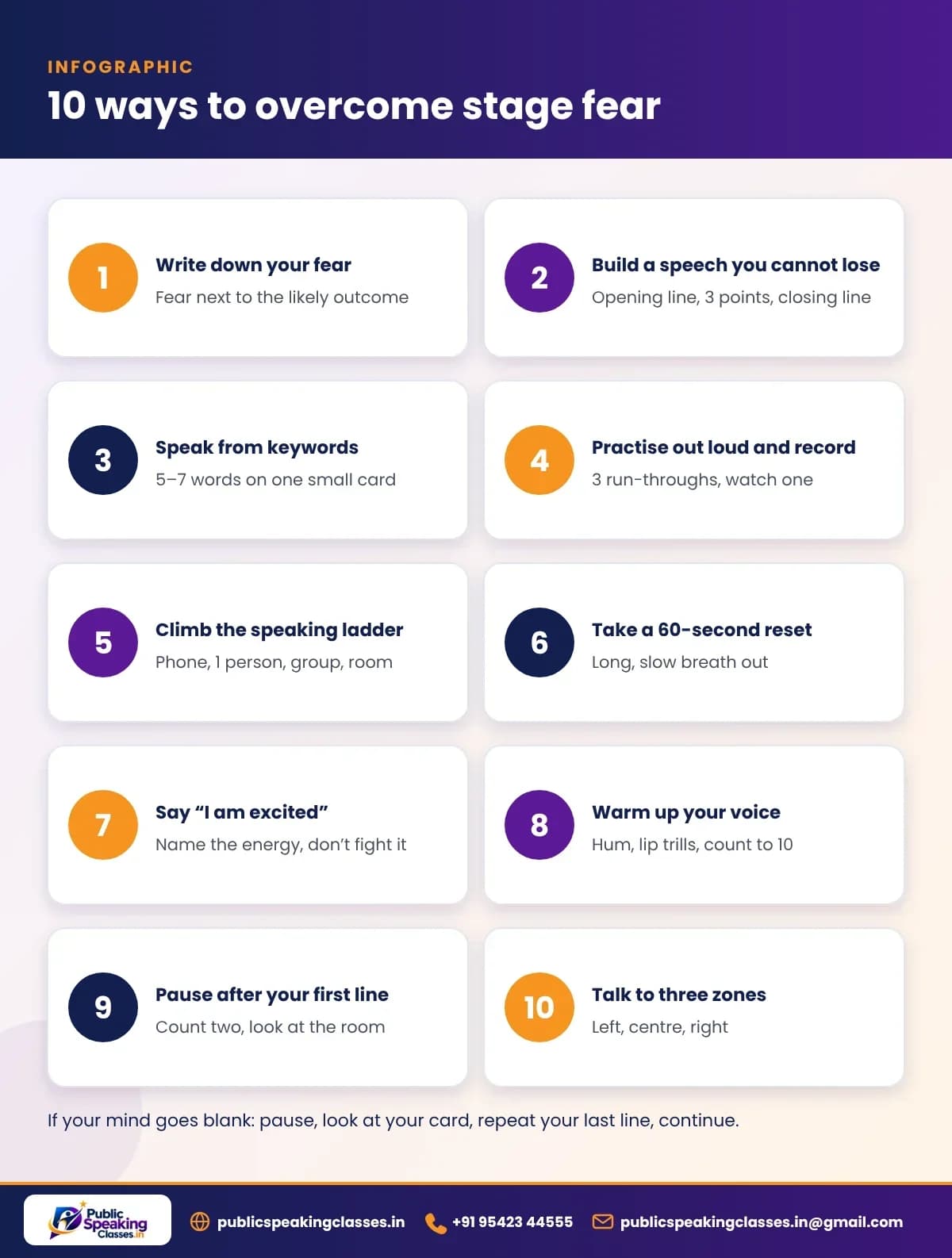
These 12 steps help you overcome stage fear before, during and after you speak:
- Steps 1 to 5: the days before your speech
- Steps 6 to 8: the day itself
- Steps 9 to 12: when you are on stage
- Each step ends with a small exercise you can do today.
Step 1 · Days beforeWrite down what you are actually afraid of
Fear grows when it stays vague.
- Take a sheet of paper and make two columns.
- On the left, write what you fear will happen: "I will forget my points", "people will laugh", "my voice will shake".
- On the right, write what is most likely to happen and what you would do about it: "I may forget one point, so I will keep a keyword card".
- Seeing the realistic answer next to the fear makes the fear smaller.
- It tells you exactly what to prepare.
Try this: 5 minutes, once, before you start practising
Example
- A final-year engineering student is nervous about her seminar.
- On the left she writes "I will forget my second point".
- On the right she writes "I will keep a keyword card and glance at it".
- She now knows exactly what to prepare: one card.
Step 2 · Days beforeBuild a speech you cannot lose
Most nervous speakers try to say too much. Use a simple shape instead:
- One opening line
- Three points
- One closing line
- Write the opening and closing lines word for word, because those are the moments when nerves are strongest.
- Everything in between can be a few keywords.
- A clear structure means that even if your mind wanders, you always know where you are and what comes next.
Try this: 15 minutes to write your opening line, three points and closing line
Example: a 2-minute self-introduction
- Opening line: "Good morning. I am Ravi, and I like solving problems with data."
- Point 1: my degree and where I studied
- Point 2: one project I am proud of, and what it changed
- Point 3: what I want to learn in this role
- Closing line: "That is why I am excited to be part of this team."
Step 3 · Days beforeSpeak from keywords, not a full script
Memorising every word feels safe, but it is fragile.
- If you forget one word, the whole speech feels lost.
Instead:
- Put five to seven keywords on a small card.
- Write them in the order you will say them.
- You will sound more natural.
- A quick look at the card brings you back on track.
Try this: Turn your speech into one card of 5–7 keywords
Step 4 · Days beforePractise out loud, standing up, and record yourself
Reading your speech silently in your head is not practice.
- Stand up.
- Speak at full volume.
- Time yourself.
- Record one attempt on your phone and watch it.
Watching yourself feels awkward at first, but it works:
- A meta-analysis of 12 studies by Bourhis and Allen found that videotaped feedback in public speaking courses led to:
- Better speech content
- Better speaking skills
- More positive attitudes
- It did this without a significant increase in anxiety.2
Try this: 3 run-throughs a day, and watch one recording
Step 5 · Days beforeClimb a speaking ladder, one step at a time
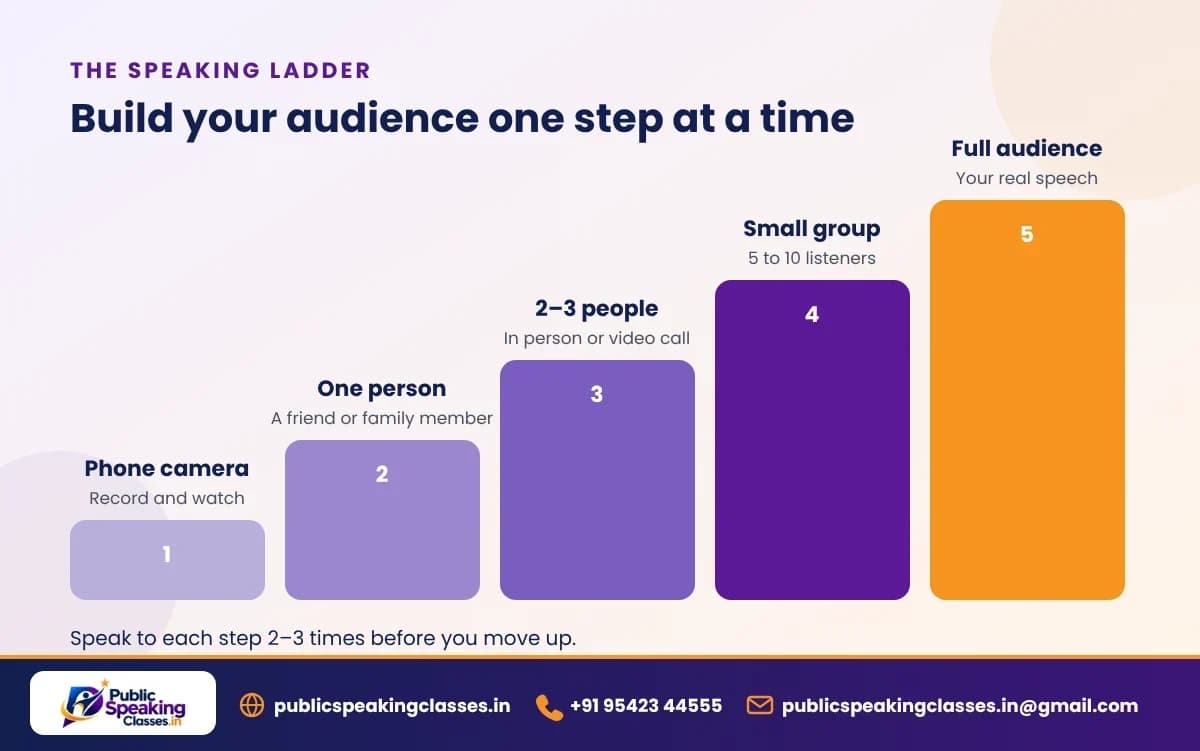
Do not jump straight from practising alone to a full hall. Build up in steps:
- Your phone camera
- One friend or family member
- A video call with two or three people
- A small group
- The real audience
- Speak to each step two or three times before moving up.
- This is exactly how our classes are built: your first speech is to one partner, then to a small group, and only then to the whole batch.
- Want regular practice between classes? Public speaking clubs such as Toastmasters International also offer a friendly audience.
Try this: Move up one step every one or two days
Example: a client demo on Friday
- Monday: record the demo on your phone and watch it
- Tuesday: present it to one teammate
- Wednesday: run it on a video call with two or three colleagues
- Thursday: full rehearsal with your team
- Friday: the client
Step 6 · On the dayReset your body with a long breath out
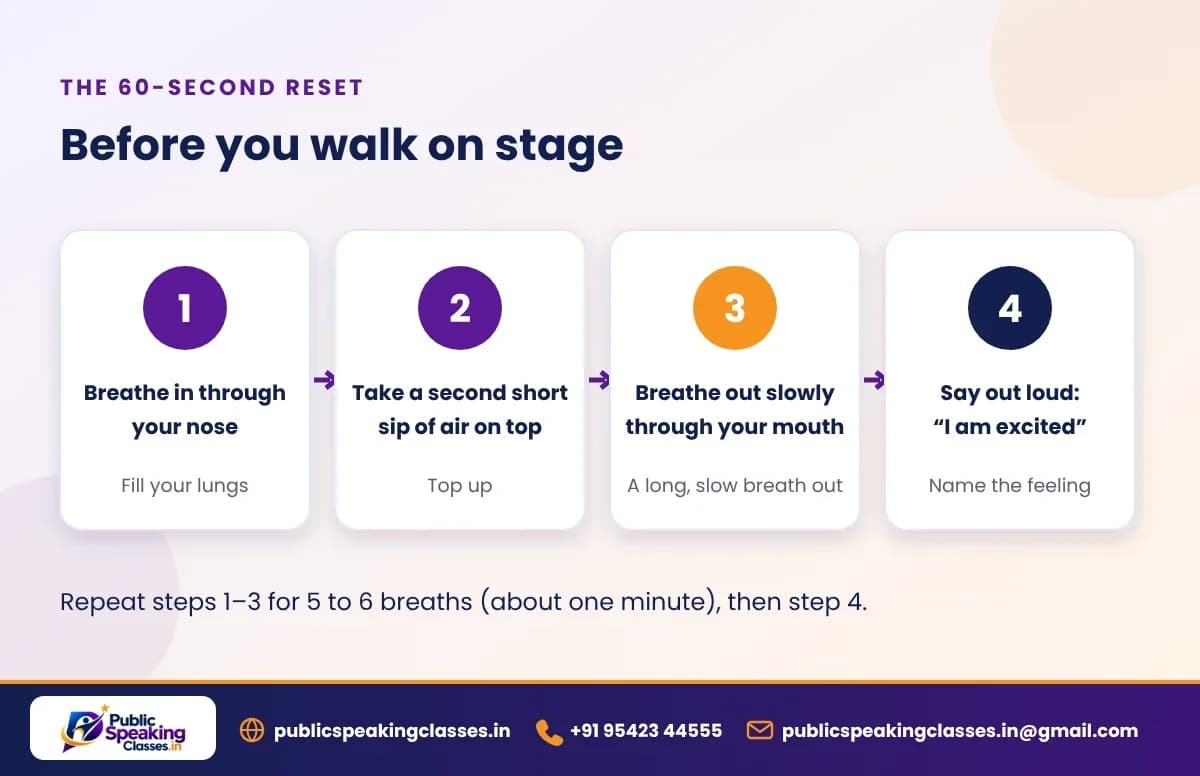
When you are nervous, your breathing gets fast and shallow. Slow it down with a long breath out:
- Breathe in through your nose.
- Take a second short sip of air on top.
- Breathe out slowly through your mouth.
- Repeat for about a minute.
- This is called cyclic sighing.
- In a 2023 randomised study in Cell Reports Medicine, five minutes of daily breathwork improved mood and reduced anxiety.
- The exhale-focused cyclic sighing improved mood more than mindfulness meditation did.3
Try this: About 1 minute, 10 minutes before you speak
Step 7 · On the daySay "I am excited", not "calm down"
- A racing heart and butterflies feel the same whether you are scared or excited.
- Instead of fighting the feeling, give it a more useful name.
- Say "I am excited" out loud before you speak, in English or in your own language.
What the research found:
- A Harvard study published in 2014 tested people preparing a persuasive speech.
- Those who said "I am excited" were rated more persuasive, competent and relaxed.
- They were compared with those who said "I am calm" (APA summary).45
Try this: Say it 3 times, just before you walk up
Expert insight
Study author Alison Wood Brooks, PhD, of Harvard Business School, explained that the way we talk about our feelings has "a strong influence on how we actually feel".5
The speech experiment compared people who said "I am excited", people who said "I am calm" and a group who said nothing.
Step 8 · On the dayWarm up your voice for two minutes
Nerves make your voice higher, faster and quieter. Warm it up the way singers do:
- Hum with your lips closed for 30 seconds.
- Do lip trills ("brrr") for 30 seconds.
- Count from 1 to 10, getting a little louder each number.
- Say your opening line out loud twice.
- Find a corridor, an empty room or even the washroom.
- Two minutes is enough.
Try this: 2 minutes, within half an hour of speaking
Step 9 · On stagePlant your feet and give your hands a home
Shaky legs and restless hands make you feel more nervous, and the audience notices them.
- Stand with your feet hip-width apart.
- Keep your weight even on both feet.
- Rest your hands loosely together at waist height.
- Let them move naturally when you make a point.
The habits we correct most often in first speeches:
- Hands in pockets
- Folded arms
- Fidgeting with a pen
Try this: Practise your standing position in every run-through
Step 10 · On stagePause after your first line
Nerves make you rush, especially in the first minute.
- Say your opening line.
- Stop.
- Count two in your head while you look at the audience.
- It feels long to you, but to the audience it sounds confident.
- It gives your breathing time to settle.
Try this: Mark the pause on your keyword card
Step 11 · On stageTalk to three zones, not one face
Looking at the floor, the ceiling or one friendly face makes you feel alone on stage.
- Divide the room into three zones: left, centre and right.
- Say one sentence to one person in a zone.
- Move to the next zone.
- Everyone feels included.
- You have something to do with your eyes.
Try this: Practise with three objects in your room as your zones
Step 12 · On stageIf your mind goes blank, use the 3-second rescue
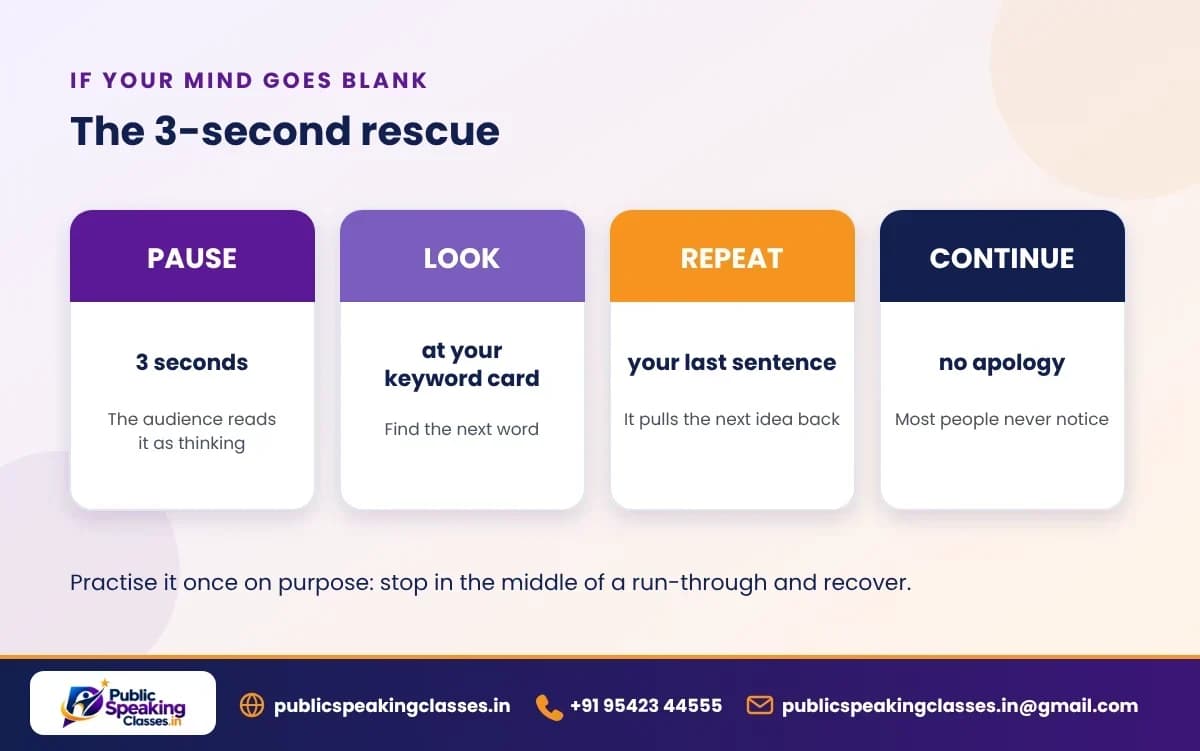
Going blank is the fear most people name first, so have a plan for it:
- Pause for three seconds (the audience reads it as thinking).
- Look at your keyword card.
- Repeat your last sentence.
- Carry on. Do not apologise.
- Most of the time, nobody even notices.
Try this: Practise it once on purpose: stop mid-speech and recover
Example
- Halfway through a wedding toast, the speaker forgets what comes next.
- He pauses.
- He looks at the word "college" on his card.
- He repeats "We have been friends since college".
- The next story comes back to him.
What should you do before going on stage?
Before going on stage, protect what you have practised: add no new material, arrive early and do a 60-second breathing reset.
The last 24 hours are about protecting what you have practised, not adding new material.
Use this timeline:
| When | What to do | Why it helps |
|---|---|---|
| The night before |
| Rewriting the speech at midnight adds new material you have not practised. |
| On the morning |
| One practice is enough to feel ready without tiring your voice. |
| When you arrive |
|
|
| 10 minutes before |
| Slows your breathing and warms your voice. |
| Just before you start |
| Turns nervous energy into focus. |
Before going on stage: checklist
Tick each item as you do it:
0 of 14 done
Download the printable checklist (PDF)
Want a safe place to practise these steps with a trainer? Your first class is free.
How to deal with stage fear in 7 days
You can deal with stage fear in 7 days by practising 15 to 30 minutes a day, moving from your phone camera to real listeners.
If you have a speech, viva or interview next week, follow this plan.
- It takes 15 to 30 minutes a day.
- It builds your audience up one step at a time.
| Day | What to practise | Time |
|---|---|---|
| Day 1 |
| 20 min |
| Day 2 |
| 20 min |
| Day 3 |
| 25 min |
| Day 4 |
| 20 min |
| Day 5 |
| 20 min |
| Day 6 |
| 30 min |
| Day 7 |
| 15 min |
Download the 7-day worksheet (PDF)
Trainer's note
Our 8-week public speaking course follows the same idea on a bigger scale:
- You speak in every class.
- First in pairs.
- Then in small groups.
- Then to the full batch.
- Every speech is recorded so you can see your own progress.
How do you go from nervous beginner to confident speaker?
Most beginners move through five stages: nervous beginner, prepared, practising, building up and confident speaker.
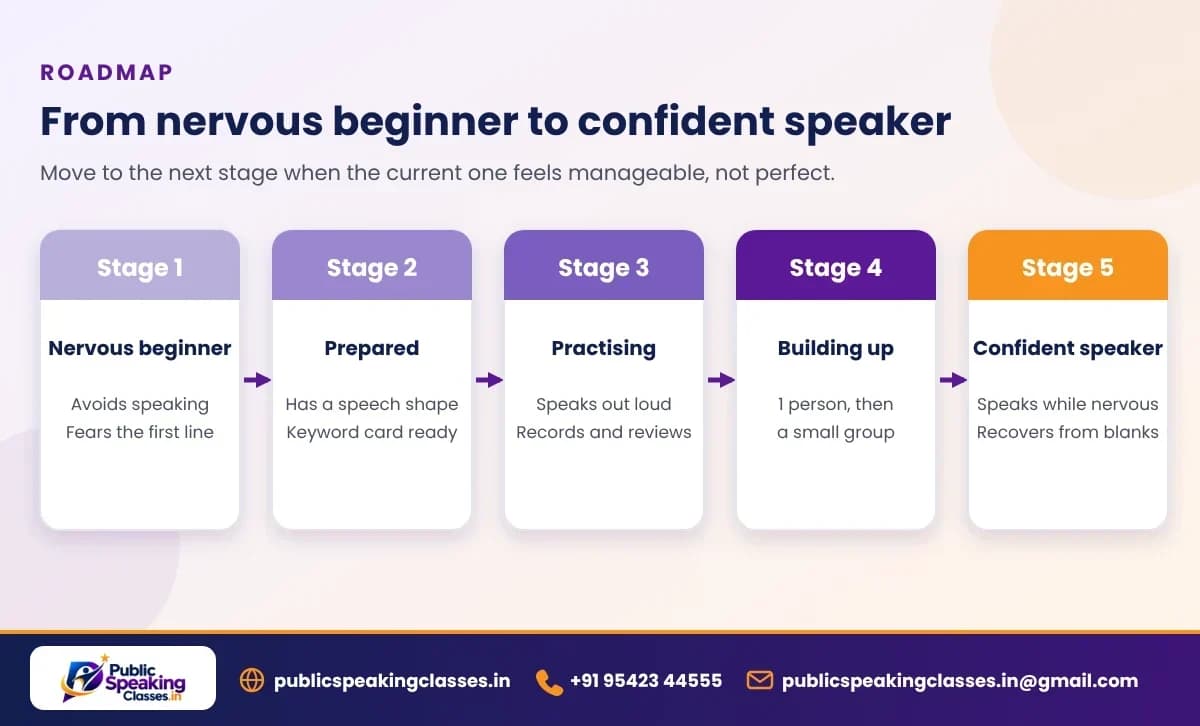
- Stage 1: Nervous beginner
- You are here if: You avoid speaking, or you dread the first line.
- Next move: Write your fear list and your speech shape (steps 1 and 2).
- Stage 2: Prepared
- You are here if: You have an opening line, three points, a closing line and a keyword card.
- Next move: Practise out loud and record yourself (step 4).
- Stage 3: Practising
- You are here if: You can get through your speech out loud without stopping.
- Next move: Speak to one real person (step 5).
- Stage 4: Building up
- You are here if: You can speak to one person, then a small group.
- Next move: Use the day-of steps in front of a bigger group (steps 6 to 12).
- Stage 5: Confident speaker
- You are here if: You still feel some nerves, but you speak clearly and recover from blanks.
- Next move: Keep speaking regularly so the skill stays.
What does a beginner's journey look like in our 8-week course?
This is how our course is built, week by week:
| Weeks | What you work on |
|---|---|
| Weeks 1–2 |
|
| Weeks 3–4 |
|
| Weeks 5–6 |
|
| Weeks 7–8 |
|
- See dates and fees for the next batches on our fees and batches page.
Which mistakes make stage fear worse?
Seven habits make stage fear worse: apologising, memorising, silent practice, reading slides, rushing, covering too much and waiting to feel confident.
These are the habits our trainers correct most often in first speeches.
Each one feels safe but makes the fear stronger.
| Mistake | Why it backfires | Do this instead |
|---|---|---|
| Starting with "Sorry, I am not a good speaker" |
| Start with your planned opening line. |
| Memorising the speech word for word | One forgotten word can make the whole speech collapse. | Speak from 5–7 keywords. |
| Practising silently in your head | Your mouth, voice and body never get the practice. | Practise out loud, standing up. |
| Reading full sentences from slides | You turn your back to the room and lose eye contact. |
|
| Rushing the first minute |
| Pause and count two after your first line. |
| Trying to cover ten points |
| Choose three points and say them well. |
| Waiting to feel confident before you practise | Confidence comes from practice, not the other way round. |
|
How is a prepared speaker different from an unprepared speaker?
| Area | Prepared speaker | Unprepared speaker |
|---|---|---|
| Opening | A planned first line | An apology or an improvised start |
| Notes | A card with 5–7 keywords | A full script, or nothing at all |
| Practice | Out loud, standing up, recorded | Silently, in their head |
| Nerves | A 60-second reset before speaking | Tries to fight the feeling |
| Mind goes blank | Pause, look, repeat, continue | Panics or apologises |
| Eye contact | Three zones of the room | The floor, the slides or one face |
| Ending | A planned closing line | "That's it" or "Thank you, that's all" |
What to do if you forget your speech on stage
If you forget your speech, pause for three seconds, look at your keyword card, repeat your last sentence and continue.
Something will go wrong at some point. Have a fix ready:
| Problem | What to do |
|---|---|
| You forget your speech |
|
| Your voice shakes |
|
| Your hands shake |
|
| Your mouth goes dry |
|
| The audience looks bored or blank |
|
| The mic or slides stop working |
|
| You are running out of time |
|
| A phone rings or someone laughs |
|
| Your heart races just before your turn |
|
The full method for going blank is step 12: the 3-second rescue.
How to reduce stage fear in interviews, presentations and events
You reduce stage fear in every situation with the same steps, plus one fix that suits that situation.
The steps are the same everywhere, but each situation has one thing that helps most.
| Situation | What helps most |
|---|---|
| Class presentation, seminar or viva |
|
| Placement interview or group discussion |
|
| Office meeting or client call |
|
| Wedding, event or college fest |
|
| Online meeting or video interview |
|
| Speaking in English when you think in Telugu or Hindi |
|
Example: a campus group discussion in two days
- Day 1: pick three likely topics and write one 20-second point for each.
- Day 2: say each point out loud three times and record one attempt (step 4).
- In the GD: speak within the first three turns with one point, then listen and add one example later.
Why it works: you speak before the fear has time to build, and you only need one prepared point to start.
Example: a first presentation at work when you think in Telugu
- Step 1: practise the presentation once in Telugu, so the ideas are clear.
- Step 2: say the same presentation in English from a keyword card (step 3).
- Step 3: before the meeting, do the 60-second reset (step 6) and say your English opening line twice.
Why it works: you deal with the language and the fear one at a time, not both at once.
Practise for your next presentation, interview or event in a batch of no more than 10.
Free stage fear practice kit (PDF)
The free stage fear practice kit is a 4-page PDF with a cheat sheet, a preparation template, a 7-day worksheet and a checklist.
Print it, fill it in and keep it with you. The free PDF has four pages:
- Cheat sheet: quick tips to remember before speaking
- Preparation template: opening line, three points, closing line and your keyword card
- Worksheet: the 7-day stage confidence challenge with daily exercises
- Checklist: before going on stage
Download the stage fear practice kit (PDF, 4 pages)
Cheat sheet: quick tips to remember before speaking
- Opening line, three points, closing line.
- Keyword card in your hand.
- One long, slow breath out.
- Say "I am excited".
- Feet planted, hands at waist height.
- First line, then count two.
- Left, centre, right.
- Blank? Pause, look, repeat, continue.
When does stage fear need professional help?
Stage fear needs professional help when it stops you from studying, working or living normally.
For most people, stage fear eases with preparation and practice.
It may be part of social anxiety disorder if the fear:
- Makes you avoid classes, interviews or work.
- Keeps you anxious for days before an event.
- Comes with panic attacks.
- The US National Institute of Mental Health estimates that 7.1% of US adults had social anxiety disorder in the past year.6
If practice alone does not help:
- Mayo Clinic advises considering professional help such as cognitive behavioural therapy.7
- Cognitive behavioural therapy is a skills-based approach that can ease the fear of public speaking.
- We are trainers, not therapists.
- Many people do both: therapy for the anxiety, and practice with a trainer for the speaking skills.
How our classes help with stage fear
- Batches of no more than 10, so the room never feels like a crowd.
- Your first speech is to one partner, then a small group, then the full batch.
- Every speech is recorded and reviewed with your trainer.
- Classes in English, Hindi, Telugu and Kannada, in our classrooms or live online.
- See our public speaking course for adults.
- If you are a parent of a nervous child, see our public speaking classes for kids.
How did we choose these techniques?
We chose these techniques from our trainers' class experience and kept the ones that published research supports.
- We started from our trainers' notes on the first speeches learners give in our classes.
- We kept techniques we use in every batch, such as the speech shape, the keyword card, the speaking ladder and recorded feedback.
- Where we mention research, we link to the original study or an official source.
- We left out popular tips that we could not support with class experience or evidence.
- A lead trainer reviewed the guide before publishing. About our team.
We update this guide when the research changes or when our trainers find a better way to teach a step.
Where can you keep practising public speaking?
You can keep practising with our free kit, public speaking clubs, official mental health sources and live classes.
- Stage fear practice kit (PDF): cheat sheet, template, worksheet and checklist.
- Toastmasters International: public speaking clubs where you can practise regularly.
- US National Institute of Mental Health: information on social anxiety disorder.
- American Psychological Association: the "I am excited" study summary.
- Our online public speaking course: live practice with feedback from home.
- Our blog: more free guides from our trainers.
- Contact us: call, WhatsApp or visit our Hyderabad classroom.
Stage fear FAQs
Short answers to the questions people ask most about stage fear.
How long does it take to remove stage fear?
There is no fixed timeline.
- Stage fear drops a little with every speech you give to real listeners.
- So the number of speeches matters more than the number of days.
- That is why our 8-week course gives you a speech in every class: 16 speeches in total, each one recorded for feedback.
Is it normal to have stage fear?
Yes.
- In the 2026 Chapman University Survey of American Fears, 28.9% of adults said they were afraid or very afraid of public speaking.
- Experienced speakers still feel nervous.
- They have simply practised speaking while nervous.
Can stage fear be removed completely?
For most people it does not disappear completely, and it does not need to.
- The goal is to speak clearly while you feel some nervousness.
- With practice, the fear becomes smaller, shorter and easier to manage.
What should I do if my mind goes blank on stage?
- Pause for three seconds.
- Look at the keyword card in your hand.
- Repeat your last sentence.
- Carry on.
- The audience reads a short pause as you thinking.
- Do not apologise for the blank.
How can I remove stage fear before an interview?
- Prepare your answer to "Tell me about yourself" and two other likely questions.
- Practise them out loud three times and record one attempt.
- On the day, arrive early.
- Do the 60-second breathing reset.
- Plan your first sentence for each answer.
Does practising in front of a mirror help with stage fear?
It helps as a first step, because you practise out loud.
- But a mirror makes you watch yourself instead of an audience.
- Move on quickly to recording yourself on your phone.
- Then speak to one real person.
Can I join a public speaking class if I have severe stage fear?
Yes. In our classes:
- Your first speech is to one partner.
- Then to a small group.
- Only then to the full batch of no more than 10.
- You can try a free demo class first and decide after that.
- For children aged 6 to 16, see our classes for kids.
Ready to give your first speech in a safe room? Book a free demo class.
Sources
Every statistic and study in this guide is numbered in the text and listed here.
- Chapman University, Survey of American Fears, Wave 11 (2025) vs Wave 12 (2026).
- Bourhis, J. and Allen, M. (1998), The role of videotaped feedback in the instruction of public speaking: a quantitative synthesis of published empirical research.
- Balban, M. Y. et al. (2023), Brief structured respiration practices enhance mood and reduce physiological arousal, Cell Reports Medicine 4(1).
- Brooks, A. W. (2014), Get excited: reappraising pre-performance anxiety as excitement, Journal of Experimental Psychology: General 143(3).
- American Psychological Association (2013), Getting excited helps with performance anxiety more than trying to calm down, study finds (press release).
- US National Institute of Mental Health, Social anxiety disorder statistics.
- Mayo Clinic, expert answer by Craig N. Sawchuk, Ph.D., L.P., Fear of public speaking: How can I overcome it?
- Wikipedia, Stage fright.
- Wikipedia, Glossophobia.
Note:
- Stage fear is different for everyone, and results vary from person to person.
- This guide shares general information from our training experience.
- It is not medical advice.
Reviewed by
Rupesh, Lead Trainer · 8 years of training experience
- Reviewed on .
- Checked that each step matches how we teach in class.
- Checked every statistic against its source.